Committee guide
How to run a box league at your tennis club
The short answer
To run a tennis box league, split your players into boxes of 4 to 6 by level, have everyone in a box play everyone else once, rank each box on points, and move the top players up and the bottom players down for the next season. With 21 players and a target of 5 per box you get five boxes, 34 matches, and no one plays more than four.
It is week six of the club ladder and half the names have not played in a month. The player at the top is bored. The player at the bottom has quietly stopped coming. Nobody is being unreasonable. Everyone just has nobody specific to play.
A box league fixes that by giving everyone a short, fixed list of opponents and a deadline.
What is a box league?
Players are split into small groups called boxes, usually by level. Everyone in a box plays everyone else once. When the season ends, the top of each box moves up and the bottom moves down. It is a round robin with a staircase on top.
How big should a box be?
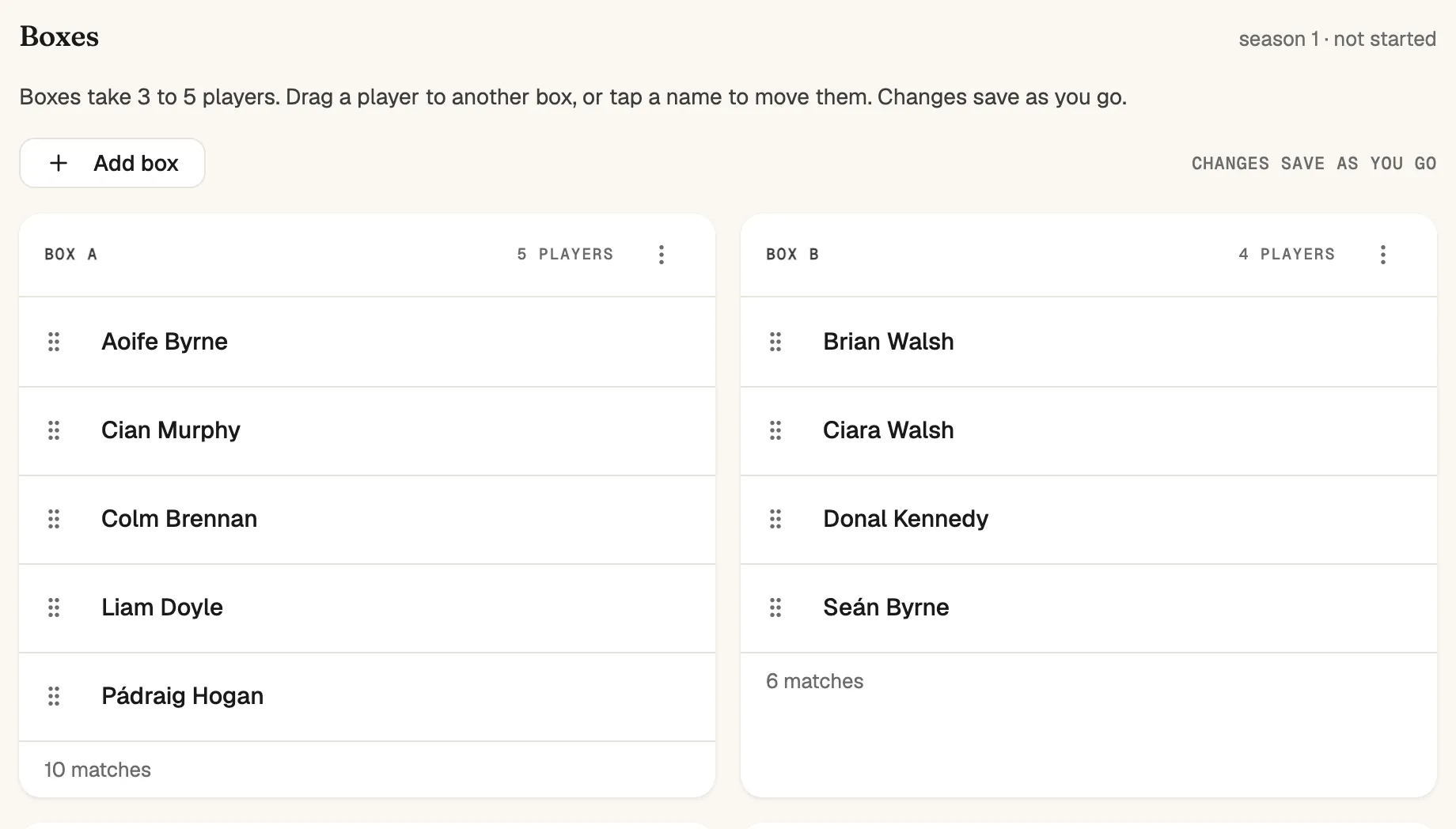
Five. Four to six works, and five is the sweet spot: each player has four matches, which is a season, not a chore. Past six it drags. A box of eight means seven matches each, and by the fifth the table has stopped meaning anything. On laceup a box can be 3 to 10 players, but you should treat 10 as a ceiling, not a target.
How do you put players into boxes?
By level, strongest in Box A. If you have last season's results, use them. If you do not, ask players for a rating when they enter and sort on that. Uneven numbers are fine: the extra players are spread across the boxes so no two boxes differ by more than one player. You need at least two boxes, so the smallest league laceup will build is six players in two boxes of three. Here are 21 players worked through.
| Box | Players | Matches each | Matches in the box |
|---|---|---|---|
| Box A | 5 | 4 | 10 |
| Box B | 4 | 3 | 6 |
| Box C | 4 | 3 | 6 |
| Box D | 4 | 3 | 6 |
| Box E | 4 | 3 | 6 |
| Total | 21 | 3 or 4 | 34 |
The extra player goes in Box A. A box of n players plays n times (n minus 1) divided by 2 matches.
How does promotion and relegation work?
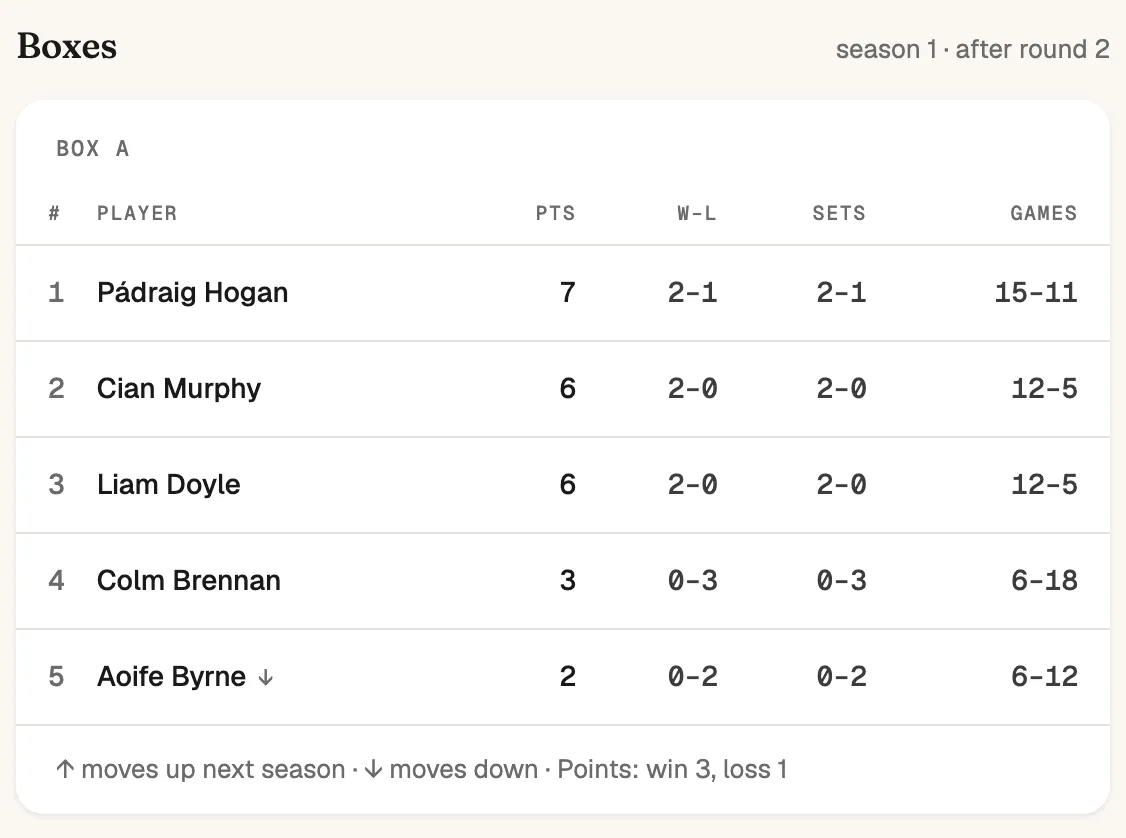
The top players in each box move up a box at the end of the season and the bottom players move down, and the table decides who. One up and one down is the usual setting, and the default on laceup. The top box has nowhere to go up to and the bottom box nowhere to fall, so those players simply stay put. Keep the number moving small: laceup will not let you move more players than your smallest box holds.
How do you score a box league?
Pick one of three. Simple gives 3 points for a win and 1 for a loss. USTA scoring gives 3 for a win and 1 for a loss, plus 1 for every set you win, so a close defeat still counts. Games won gives 1 point for every game. Our advice is Simple. A point for losing sounds odd, but it is why people keep turning up when they are already last.
How do you run a season, step by step?
- Choose the dates and the pace: a round every week or two, or play any time before the end date.
- Open entries and set the box size.
- Close entries. Seed players by level.
- Make the boxes and send each player their list of opponents.
- Give every round a deadline and record results as they come in.
- At the end, move the top and bottom of each box and start the next season.
What goes wrong in a box league?
No-shows. One player who stops replying holds up everyone in their box, because you cannot finish a box with a missing match. Decide before you start what counts as a walkover and who decides. On laceup a player can ask for a walkover and the organiser rules on it, and you can switch walkovers off altogether.
Can laceup run a box league for you?
Yes. A club admin creates the league, and laceup makes the boxes, the fixtures and the standings, and shows who moves up and down. Everything above also works with a spreadsheet and a printed rules sheet.
Common questions
- How many players do you need for a box league?
- Six at the very least, which gives two boxes of three. With 12 or more you get at least three boxes, which makes promotion mean something.
- How many matches does each player play?
- One fewer than the number of players in their box. In a box of five, that is four.
- What if the number of players does not divide evenly?
- The extra players are spread across the boxes, so box sizes never differ by more than one. 21 players aiming for boxes of 5 gives one box of 5 and four boxes of 4.
- Should a box league have a deadline for each round?
- Yes. Without one, the last match in each box never gets played. Pick a pace, such as a round a week or a fortnight, or set one end date and let people play any time before it.
- Is a box league better than a ladder?
- They solve different problems. A ladder runs all season and ranks everyone on one list. A box league gives each player a fixed set of opponents and a finish line, which is why it tends to work for clubs where a ladder goes quiet.